
There are places in Japan that feel almost impossible to describe until you see them for yourself.
Beppu, on the island of Kyushu, is one of them.
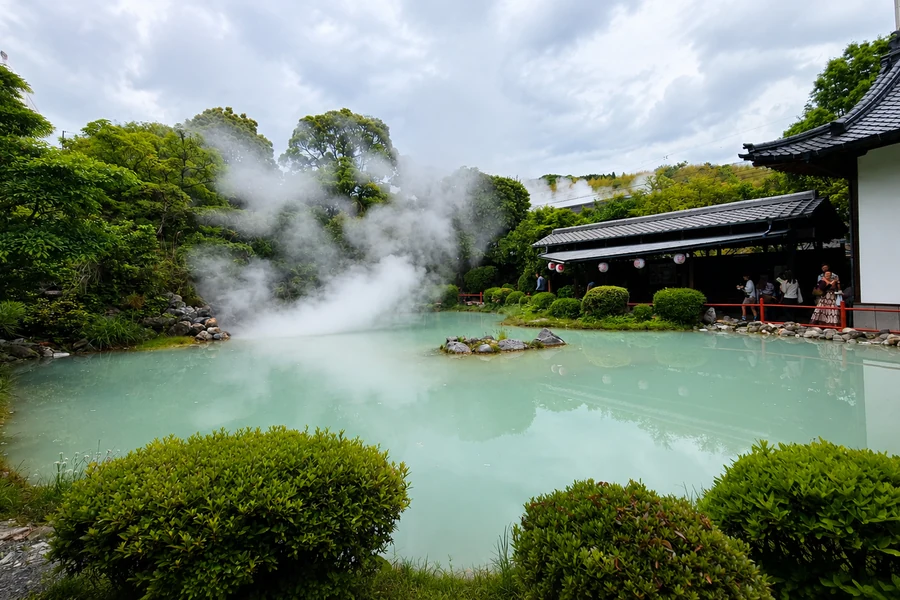
This famous hot-spring city is known for its enormous amount of geothermal activity. Steam rises from the ground, hot water flows beneath the city, and in some places the landscape looks as though you have stepped onto another planet.
The most famous attraction is Beppu Jigoku Meguri — the Seven Hells of Beppu.
Despite the dramatic name, these are not places of darkness or anything sinister. The word jigoku simply refers to the boiling, inaccessible hot springs that have fascinated people for centuries. The seven sites each have their own appearance, color and geological characteristics.
I visited Beppu and spent time exploring the hells, and what surprised me most was how different each location felt. Some were intensely blue, others deep red, while others were filled with boiling mud or enormous clouds of steam.
And surrounding all of this volcanic activity were beautiful Japanese gardens, ponds and traditional buildings.
That contrast is what makes Beppu so memorable.

What Are the Seven Hells of Beppu?
The Seven Hells are:
- Umi Jigoku (Sea Hell)
- Oniishibozu Jigoku (Oniishi Shaven Monk Hell)
- Kamado Jigoku (Cooking Pot Hell)
- Oniyama Jigoku (Demon Mountain Hell)
- Shiraike Jigoku (White Pond Hell)
- Chinoike Jigoku (Blood Pond Hell)
- Tatsumaki Jigoku (Tornado Hell)
The attraction is divided between two areas: Kannawa, where five of the hells are located, and Shibaseki, where Chinoike Jigoku and Tatsumaki Jigoku are found. The two areas are roughly 3 km apart.
This is an important detail when planning your visit because you shouldn’t assume that all seven attractions are right next to each other.
Umi Jigoku: The Blue Sea Hell
Umi Jigoku was one of the most impressive places I visited in Beppu.
The water is an extraordinary cobalt blue, almost like a tropical lagoon.
Except that this is definitely not a swimming pool.
The temperature of the water is around 98°C, making it far too hot for bathing. The intense blue color comes from the geothermal conditions and minerals in the water. Umi Jigoku is also the largest of the seven hells, reaching around 200 meters in depth.

What makes Umi Jigoku particularly beautiful is the landscape around it.
The steaming blue pond is surrounded by greenery and a carefully maintained Japanese garden. There are also smaller ponds with water lilies and traditional landscaping.
Walking around the area, I found myself constantly switching between two completely different impressions: the power of volcanic nature and the calm precision of a Japanese garden.
That combination is quintessentially Japanese.
A Japanese Garden in the Middle of a Volcanic Landscape
One of the things I liked most about Beppu was that the visit wasn’t simply about looking at hot springs.
There are peaceful gardens throughout the area, with ponds, water lilies, rocks, carefully shaped shrubs and mature trees.

This was one of my favorite contrasts of the day.
On one side, you have boiling water and steam rising from deep underground. On the other, there is a perfectly peaceful pond covered with water lilies.
The gardens also make the visit much more pleasant because you aren’t simply moving from one attraction to another. There are plenty of places where you can slow down, take photographs and enjoy the scenery.
Shiraike Jigoku: The White Pond Hell
Shiraike Jigoku offers an entirely different atmosphere.
Instead of the brilliant blue of Umi Jigoku or the red color of Chinoike Jigoku, the water here has a pale, milky appearance.
The official tourism information describes Shiraike as a particularly peaceful hell, with a Japanese-style garden surrounding the pond. It is also one of the four hells designated as a National Place of Scenic Beauty.
This is a good example of why visiting all seven is worthwhile.
If you only see photographs of Umi Jigoku, you might assume the hells are simply different versions of the same attraction.
They aren’t.
The colors, landscape and atmosphere change considerably from one location to another.
Chinoike Jigoku: The Blood Pond Hell
Then comes one of the most dramatic locations on the entire route.
Chinoike Jigoku literally means “Blood Pond Hell.”
The water has a deep reddish-orange color because of the minerals and red clay associated with the geothermal environment.

Standing in front of this pool, with steam drifting across the surface and dense green vegetation rising behind it, was probably one of the most unusual landscapes of the trip.
The official Oita tourism website describes Chinoike Jigoku as the oldest natural hell in Japan, with a history of more than 1,300 years.
There is also an observation area, making this one of the better locations for photography.
When the Ground Starts Boiling
Some of the Seven Hells are impressive because of their color.
Others are impressive because of what is actually happening beneath your feet.

At several locations, you can see hot mud bubbling and geothermal steam escaping from the ground.
Oniishibozu Jigoku is particularly known for its round bubbles of boiling gray mud. The bubbles resemble the shaved heads of Buddhist monks, which is where the name comes from.
It is a much more raw-looking landscape than the beautifully landscaped Umi Jigoku.
And that contrast is exactly what makes the Jigoku Meguri interesting.
Oniyama Jigoku: The Crocodile Hell
One of the strangest stops is Oniyama Jigoku, also known as Crocodile Hell.
The geothermal water here has been used to keep crocodiles and alligators, and the attraction currently has around 80 animals.
It’s certainly not what you expect to find in the middle of a traditional Japanese hot-spring town.
But that’s Beppu.
You can spend the morning looking at elegant Japanese gardens and cobalt-blue hot springs and then suddenly find yourself watching crocodiles living in geothermal heat.
Tatsumaki Jigoku: A Natural Geyser
The final two hells are located in the Shibaseki area, separated from the main group.
Tatsumaki Jigoku, or Tornado Hell, is different from the others because it behaves like a natural geyser.
Instead of a constantly bubbling pool, hot water and steam erupt periodically from underground.
The official Oita tourism information says the geyser erupts roughly every 30–40 minutes, with each eruption lasting around 6–10 minutes.
This is one place where planning your timing actually matters.
If you arrive just after an eruption, you may have to wait for the next one.
Can You Visit the Seven Hells by Bus?
Yes — and this is worth knowing if you don’t want to drive.
From Beppu Station, local buses reach the Kannawa area in around 20 minutes. Once you arrive, the five hells in Kannawa can largely be explored on foot.
There is also a dedicated sightseeing bus that takes visitors around all seven hells in approximately 2–3 hours.
So you absolutely do not need a car to visit Beppu Jigoku Meguri.
But I would still recommend renting one.
If you’re traveling with family, friends or a small group, having a car makes the day considerably easier.
The two areas are about 3 km apart, and you don’t have to organize your day around bus schedules. All seven hells have parking available.
With a rental car, you can simply finish one group of hells, get in the car and drive to the next area.
The bus is convenient. The car is faster and more flexible.
For a larger Kyushu road trip, I would choose the car without hesitation.
How Much Time Should You Spend in Beppu?
If you are interested only in seeing the seven hells, you can move through them relatively quickly.
But I would not recommend rushing.
The official tourism information suggests around three hours for the complete Jigoku Tour, while allowing a full day makes more sense if you want to explore Kannawa, eat, take photographs and experience the area’s onsen culture.
I would plan something like:
Morning
Umi Jigoku
→ Oniishibozu Jigoku
→ Kamado Jigoku
→ Oniyama Jigoku
→ Shiraike Jigoku
Lunch
Try local jigoku-mushi food.
Afternoon
Drive to Shibaseki
→ Chinoike Jigoku
→ Tatsumaki Jigoku
Evening
Finish the day with an actual onsen experience.
That gives you enough time to enjoy the surroundings instead of simply collecting entrance stamps.
Don’t Leave Without Trying Jigoku Mushi
Beppu’s geothermal activity isn’t only something you can see.
It can also cook your lunch.
Jigoku-mushi means roughly “hell-steamed” food. Ingredients such as vegetables, seafood, meat and eggs are cooked using natural hot-spring steam.
The technique dates back to the Edo period and remains one of Beppu’s characteristic food experiences.
You can also find things such as hot-spring eggs and steamed pudding.
It’s one of those traditions that makes perfect practical sense:
If the ground is producing huge amounts of hot steam, why waste it?
How to Get to Beppu from Tokyo
This is where Beppu becomes an especially interesting option for people living in Tokyo.
Beppu is not a quick day trip from Tokyo — it is in Oita Prefecture on Kyushu, Japan’s third-largest main island.
The easiest option is generally to fly from Tokyo Haneda to Oita Airport. JNTO gives the flight time as approximately 1 hour 35 minutes, followed by a bus from Oita Airport to Beppu.
And this is exactly why I think trips like this are worth doing.
When you live in Tokyo, it can be tempting to spend all your weekends exploring the surrounding areas.
But Japan is made up of several major islands and countless regions, and the atmosphere can change dramatically from one part of the country to another.
Kyushu feels different.
The volcanic landscape, mountains, hot-spring towns and local food make it an excellent destination for a longer weekend or a road trip.
Why I Think Beppu Is Worth the Trip
There are plenty of beautiful places in Japan.
But Beppu isn’t simply beautiful.
It’s unusual.
You see a bright blue pool of almost boiling water.
Then a red one.
Then boiling mud.
Then enormous clouds of steam.
Then a perfectly manicured Japanese garden.
Then crocodiles.
Then another steaming pond hidden among the trees.

And all of this is happening in one relatively small area.
That is what I enjoyed most about Beppu.
It doesn’t feel like a collection of artificial tourist attractions. The entire area is built around the extraordinary geothermal activity that has shaped the city for centuries.
Final Thoughts
If you’re visiting Japan for the first time, Tokyo, Kyoto and Osaka will probably be high on your list.
But once you’ve seen the major cities, start looking beyond the standard itinerary.
Traveling to other islands and regions of Japan is one of the best ways to understand just how diverse the country really is.
Beppu is a particularly good choice if you love:
- hot springs and onsen culture;
- unusual natural landscapes;
- Japanese gardens;
- photography;
- road trips;
- local food;
- places that feel genuinely different from Tokyo.
And if you have a rental car, even better.
The buses make the Seven Hells perfectly accessible without a car, but driving gives you much more freedom and makes the two Jigoku areas significantly easier to combine in one day.
For me, the biggest takeaway from Beppu was simple:
Japan isn’t just Tokyo, Kyoto and Osaka.
Sometimes the most memorable experiences are waiting on another island.


No responses yet