
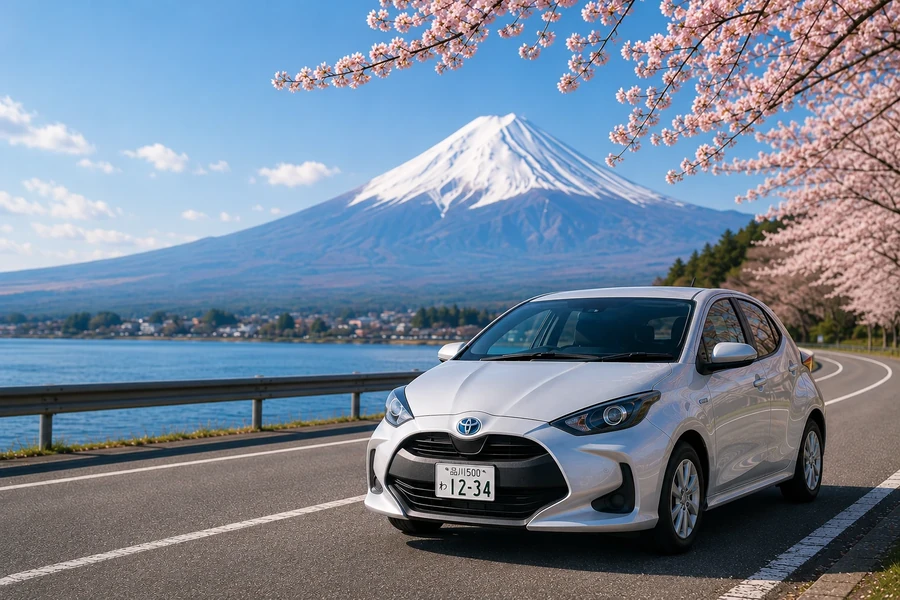
Renting a car in Japan can be one of the best ways to explore the country beyond the major cities.
In Tokyo, Kyoto, and Osaka, public transportation is usually easier and often faster. Once you leave the city centers, however, a car can make a huge difference. It gives you more freedom to visit rural villages, mountain towns, scenic coastlines, hot spring resorts, beaches, lakes, and places that are difficult to reach by train.
A rental car is especially useful in Hokkaido and Okinawa, where driving makes it much easier to explore the islands at your own pace.
There is one important thing to understand before you make a reservation:
Your regular driver’s license does not automatically give you the right to drive in Japan.
The documents you need depend on the country that issued your license.
This guide explains how to rent a car in Japan as a foreign traveler, including license requirements, International Driving Permits, insurance, ETC cards, parking, fuel, toll roads, winter driving, ferry travel, and tips for choosing a rental company.

Can Foreign Tourists Rent a Car in Japan?
Yes. Foreign visitors can rent cars in Japan as long as they have the documents required to legally drive in the country.
Most rental companies will ask to see:
- your passport
- your original driver’s license
- a valid International Driving Permit or official Japanese translation, depending on your country
- a payment card
- documents for every driver listed on the rental agreement
The important part is that every person who intends to drive must meet the Japanese requirements. The person who made the reservation cannot simply let another traveler drive without adding them to the rental agreement and checking their documents. Times CAR RENTAL, for example, requires every driver to present the relevant license, passport, and payment method at pickup.
What Driving Documents Do You Need in Japan?
This is the most important part of renting a car in Japan.
Japan does not simply accept every document called an “international driving license.”
Travelers Using an International Driving Permit
For travelers whose countries follow the applicable Geneva Convention route, Japan requires an International Driving Permit issued under the 1949 Geneva Convention on Road Traffic.
You also need to carry your original passport and national driver’s license where applicable.
The IDP must be the correct 1949 Geneva Convention format. Japan does not recognize IDPs issued under the 1968 Vienna Convention for driving in Japan.
This distinction matters because some European countries use different international driving arrangements, and simply asking for an “international license” can result in getting a document that is useless in Japan.
Travelers from Germany, France, Belgium, Monaco and Switzerland
These travelers follow a different procedure.
You must carry:
your valid original driver’s license + an official Japanese translation + passport.
The translation can be issued by the Japan Automobile Federation (JAF) or another authorized organization, depending on the country.
This is also why you should check the requirements based on the country that issued your driving license, not simply your nationality.
What About Travelers from Ukraine and Other CIS Countries?
This is where it is particularly important not to put every CIS country into one category.
Travelers from Ukraine, Russia, Kazakhstan, Uzbekistan, Moldova, Georgia, Armenia, Azerbaijan and other countries should check the exact current rules for the country that issued their driver’s license and their IDP.
For countries using the International Driving Permit route, the permit must be a valid 1949 Geneva Convention-format IDP issued by the competent authority. Rental companies can refuse a rental if the permit is not valid or cannot be verified as properly issued.
So before booking a car, check your situation through the official Japanese sources or directly with your rental company.
Do not rely on a generic “international license” sold online.
Does Japan Accept a Digital International Driving Permit?
This is an important detail that catches many travelers by surprise.
Japan requires a booklet-type paper International Driving Permit for the IDP route.
Card-style or smartphone versions are not valid for driving in Japan.
So if a website offers you a “digital international driving license” that exists only inside an app, do not assume it will work at a Japanese rental counter.
Bring the original physical document.
Your Passport Entry Stamp Can Matter
There is another surprisingly important detail.
The period during which an IDP can be used in Japan is linked to the date you entered Japan. Rental companies may verify that date using the landing/entry stamp in your passport. Times specifically warns that travelers who pass through automated immigration gates may need to obtain an immigration stamp or landing permission seal; without proof of the entry date, the rental company may not be able to rent the car.
If you plan to rent a car after arriving in Japan, it is worth thinking about this before leaving the airport.
How Long Is an International Driving Permit Valid in Japan?
An IDP is generally valid for up to one year from the date of issue, but the period during which you can actually use it for driving in Japan is also limited by the Japanese rules based on your date of entry.
In general, the driving period is limited to one year from entry into Japan, subject to the rules applicable to your situation.
For foreign residents of Japan, additional rules can apply, especially after leaving and re-entering the country.
This is one reason long-term residents should not assume that a newly issued IDP automatically resets everything.
What Documents Should You Bring to the Rental Counter?
I recommend keeping everything in one folder rather than trying to find documents at the counter while a queue forms behind you.
Bring:
Passport
Original driver’s license
Valid 1949 Geneva Convention IDP
or
Official Japanese translation, if your country follows the translation route
Credit card
Rental reservation confirmation
And remember that additional drivers need their own valid documentation.
Toyota Rent a Car and Times both explicitly warn that rentals can be refused if the required documents do not meet Japanese rules.
Which Car Rental Companies Are Good in Japan?
Japan has several large nationwide rental companies, plus many smaller and budget operators.
For a first trip, I would compare the total rental cost and pickup conditions, not simply choose the company with the lowest headline price.
TOYOTA Rent a Car
Toyota is one of the easiest options to consider for first-time visitors.
Its international website provides detailed information about foreign driving documents and lets travelers check whether their license situation qualifies before the trip.
Best for: first-time visitors who want a major nationwide brand and straightforward international information.

Times CAR RENTAL
Times has a large network and provides detailed English-language information for foreign drivers.
The company also offers ETC-related services and provides extensive information about international driver’s licenses.
Best for: travelers who want a major Japanese operator with good information for international customers.
NIPPON Rent-A-Car
NIPPON Rent-A-Car is another major nationwide option and offers services such as one-way rentals, which can be useful for road trips that end in a different city.
Best for: multi-city itineraries and longer road trips.
Niko Niko Rent a Car
Niko Niko Rent a Car (ニコニコレンタカー) is worth checking when your priority is keeping the rental budget down.
It has a large network of locations, and some branches accept international driver’s permits. However, foreign travelers should pay particular attention to the individual branch conditions.
Niko Niko states that international-license rentals are available at participating locations, but the rental procedure is conducted in Japanese. The company also says that the contracting customer must be able to handle the process in Japanese and that interpreters or translation apps are not accepted for the contract procedure.
This is a very important difference for international visitors.
A low rental price is not necessarily a bargain if you arrive at the counter and discover that communication is a problem.
Best for: budget-conscious travelers who can handle a Japanese-language rental procedure or already know how the specific branch operates.
Niko Niko also has participating locations near airports, including Haneda and Narita, and some locations offer ETC card rentals. Conditions vary by branch.
Is Niko Niko Better Than Toyota or Times?
Not necessarily.
Niko Niko can be attractive because of price, but the cheapest daily rate is not the only thing that matters.
Before comparing companies, look at:
- insurance or compensation options
- ETC card availability
- child seat fees
- one-way fees
- pickup and return hours
- airport transfer arrangements
- language support
- vehicle age and condition
- mileage restrictions, if any
- cancellation conditions
For an international traveler, ease of pickup can be worth paying a little more for.
What Size Rental Car Should You Choose in Japan?
This is another place where travelers often make the wrong calculation.
A large vehicle is not automatically better.
Japanese roads can be narrow, parking spaces can be compact, and some rural roads are surprisingly tight.
For two people with a couple of suitcases, a compact car is often ideal.
For families, however, luggage becomes more important than seat count.
A practical rule is:
2 people: compact car
3–4 people: compact or small wagon
4–5 people with lots of luggage: larger wagon or minivan
Check the actual luggage capacity before booking.
Five seats do not necessarily mean five adults plus five large suitcases will fit comfortably.
Do You Need Automatic Transmission?
Most travelers from the US and many other countries are comfortable with automatic cars, but you should still confirm the transmission when booking.
Japan has both automatic and manual vehicles.
For most visitors who are not used to driving on the left, I would choose an automatic transmission.
There is already enough to think about when adjusting to Japanese traffic.
You do not need to turn the clutch pedal into another sightseeing attraction.
Driving on the Left in Japan
Japan drives on the left-hand side of the road.
For travelers from countries where cars drive on the right, the first few intersections require extra attention.
The difficult part is often not driving straight. It is remembering the correct lane after turning.
Take the first 20–30 minutes slowly.
Don’t start your Japanese road trip by trying to prove that you have excellent reflexes.
Do You Need an ETC Card in Japan?
For longer road trips, an ETC card can make life much easier.
ETC stands for Electronic Toll Collection and allows you to use electronic toll lanes on Japanese expressways.
The important detail is that the ETC device in the car and the ETC card are not the same thing.
A rental car can have an ETC reader without automatically including an ETC card.
Times explains that ETC cards can be rented to eligible rental-car customers, while Niko Niko also offers ETC card rental at some participating locations.
Before pickup, ask:
Does the car have an ETC device?
and:
Can I rent an ETC card?
Do not put your normal credit card into the ETC reader. Times specifically warns against this.
Should You Get a Highway Pass?
This depends on your itinerary.
Japan’s expressway tolls can become expensive on a long road trip.
Before buying a regional pass, estimate how much highway driving you will actually do.
For a short trip with only a few toll roads, paying individual tolls may be simpler.
For an itinerary with several long expressway journeys, a pass may be worth considering.
The correct answer depends on your route, not on how attractive the word “unlimited” sounds.
Do You Need Rental Car Insurance in Japan?
This is one area where I would not choose a rental company based purely on price.
Rental companies generally include basic insurance or compensation arrangements, but the exact coverage, deductible, exclusions and optional protection vary.
Read the details before booking.
When comparing two cars, calculate:
daily rental + insurance/compensation + ETC + child seat + winter tires + one-way fee
That is your realistic transportation cost.
A rental advertised at a very low daily rate can become much more expensive after optional coverage and extras are added.
Can You Add an Additional Driver?
Usually, yes, but the additional driver must meet the Japanese driving requirements and be registered according to the rental company’s procedure.
Do not assume that a spouse, friend or family member can simply take over the wheel because they are sitting in the passenger seat.
Every person who intends to drive should be properly registered and carry their own documents.
Can You Rent a Child Seat in Japan?
Many rental companies offer child seats, but availability and fees vary by company and location.
If you need one, reserve it in advance rather than assuming one will be available at pickup.
This is especially important during busy holiday periods.
Do You Need Navigation in Japan?
Not necessarily.
Google Maps can be very useful, and many travelers are comfortable using their phone for navigation.
Some rental cars also come with built-in Japanese navigation systems.
However, check the exact rental conditions because navigation may not be standard on every vehicle.
Times specifically notes that navigation availability varies by vehicle and can be selected when offered.
In rural Japan, I also recommend downloading important destinations before setting out.
Mobile coverage is generally good, but you do not want your only navigation option to disappear on a mountain road.
Parking in Japan: What Foreign Visitors Should Know
Parking deserves more attention than it usually gets.
In major cities, parking can be expensive.
In rural areas, parking is often easier, but you should still check your accommodation before arriving.
When booking a hotel, ask:
Does the hotel have parking?
Then check whether it is:
- free
- paid per night
- charged by the hour
- first-come, first-served
- limited to certain vehicle sizes
This is one reason I would not rent a car for your entire Tokyo stay.
Use trains in Tokyo.
Pick up the car when you leave the city.
Can You Drive in Tokyo?
Yes, but I usually would not recommend renting a car specifically for Tokyo sightseeing.
Traffic, parking costs, narrow streets and the excellent rail network make a car unnecessary for most visitors.
A more practical plan is:
Tokyo → train → rental car → road trip → return car → train
This lets you use public transportation where it works best and a car where it actually adds value.
When Does Renting a Car Make the Most Sense?
A rental car becomes much more useful when your trip includes:
- countryside
- mountains
- remote beaches
- lakes
- national parks
- hot spring towns
- coastal roads
- small villages
- multiple stops in one day
It is also useful when you simply want the freedom to stop when you see something interesting.
And that is one of the best things about driving in Japan.
You can leave the main tourist route, stop at a small roadside café, visit a local viewpoint, or spend an extra hour somewhere beautiful without worrying about the next train.
Road Trips to Japanese Islands
One of my favorite reasons to rent a car in Japan is exploring the islands.
Hokkaido and Okinawa are particularly well suited to road trips, and JNTO specifically notes that these islands are much more accessible by car.
A car can make an island itinerary much easier:
airport → rental car → hotel → beaches → scenic viewpoints → local restaurants → small towns → return
This is especially useful when you want to explore beyond the main resort areas.
Before choosing where to go, you can compare destinations in our guide to the best Japanese islands to visit and then decide whether a car makes sense for your itinerary.
Can You Take a Rental Car on a Ferry?
Sometimes, but never assume it is allowed.
If you plan to take a rental car to another island, check both:
the rental company’s policy
and
the ferry operator’s rules
Some rental contracts may restrict where the vehicle can travel.
Even if the ferry itself accepts cars, the rental company may have conditions about transporting its vehicle by sea.
Check before booking.
Can You Return the Rental Car in Another City?
Often, yes.
This is called a one-way rental or drop-off rental.
For example, you might drive:
Tokyo → Fuji area → Nagoya → Kyoto
and return the car in a different city rather than driving all the way back.
NIPPON Rent-A-Car offers one-way rentals, although conditions and fees depend on the route and locations involved.
Always check the one-way fee before confirming the reservation.
It can make an itinerary much easier, but it can also significantly change the final cost.
Winter Driving in Japan
If you are heading to Hokkaido, Tohoku or mountainous areas in winter, take winter driving seriously.
Ask the rental company about:
winter tires
4WD
snow chains
Availability depends on location, vehicle and season.
Do not leave this until the day of pickup.
In snowy regions, appropriate tires should be considered part of the basic trip planning rather than an optional luxury.
What Fuel Does a Japanese Rental Car Use?
Before leaving the rental location, ask exactly which fuel the car takes.
You may encounter gasoline and diesel vehicles, as well as hybrids.
Do not guess at the station.
Also check the rental company’s fuel policy.
For example, NIPPON Rent-A-Car states that vehicles are provided with a full tank and should be refueled before return according to its rental conditions.
Keep your final fuel receipt if the rental company requires proof of refueling.
What Should You Check Before Leaving the Rental Station?
Before you drive away, walk around the entire vehicle.
Look for:
- scratches
- dents
- wheel damage
- cracked mirrors
- windshield damage
- interior damage
Make sure existing damage has been recorded.
I also recommend taking several photos and a short video of the car.
It takes about two minutes.
It can save a very unpleasant conversation later.
What Traffic Rules Should Foreign Drivers Know?
Japan has strict traffic rules, and visitors should take them seriously.
The basics include:
Drive on the left.
Wear seat belts.
Never drink and drive.
Follow stop signs and traffic signals carefully.
Do not park illegally.
Watch for bicycles and pedestrians, particularly in residential areas.
Japan has strict rules concerning alcohol and driving, and rental companies provide foreign visitors with information about local traffic regulations.
What About Speed Limits?
Do not assume the speed limit from the appearance of the road.
Japan uses posted speed limits, and some rural roads may feel much wider or emptier than the speed limit suggests.
Follow the posted signs rather than driving according to what “feels reasonable.”
This is another situation where a good navigation system can help.
What Happens If You Get a Ticket?
Traffic violations can create extra paperwork for a rental car.
If you receive a traffic ticket, do not ignore it.
Follow the rental company’s instructions and deal with the ticket according to Japanese procedures.
Your rental agreement will normally explain what to do if you receive a violation notice.
Common Mistakes Foreign Visitors Make When Renting a Car in Japan
1. Booking first and checking the license later
Always verify your driving eligibility first.
2. Buying the wrong “international driver’s license”
Japan is strict about the required format.
3. Bringing only the IDP
An IDP is not a replacement for the underlying driver’s license.
4. Forgetting the passport
You need it for rental procedures and entry-date verification.
5. Arriving through an automated immigration gate without checking the stamp issue
This can create problems proving your entry date.
6. Choosing the cheapest rental based on the headline price
Extras can significantly change the final bill.
7. Renting a car for Tokyo
Usually unnecessary.
8. Ignoring parking costs
Especially in large cities.
9. Forgetting winter tires
A serious issue in snowy regions.
10. Assuming every Niko Niko location works the same way
International-license procedures and payment/language conditions can vary by branch.
My Advice for First-Time Drivers in Japan
My biggest recommendation is simple:
Start your first Japanese road trip somewhere easy.
Do not pick up a rental car in central Tokyo and make your first drive a complicated urban adventure.
Instead, take the train out of the city and rent a car when you actually need one.
For island trips, countryside travel and scenic routes, a car can be an excellent investment because it gives you flexibility that trains cannot.
And remember that the goal is not to drive as far as possible every day.
Leave enough time to stop.
Take the scenic road.
Try the small restaurant.
Stay longer when you find a place you like.
That is when a Japan road trip starts feeling like a trip rather than transportation.
Japan Car Rental Checklist for Foreign Travelers
Before booking your rental car, check:
☐ My driver’s license is valid in Japan
☐ I have the correct 1949 Geneva Convention IDP, if required
☐ Or I have the required official Japanese translation
☐ I will carry my original driver’s license
☐ I will carry my passport
☐ Every additional driver has the required documents
☐ I have checked the insurance and compensation options
☐ I know whether ETC equipment is included
☐ I know whether I need to rent an ETC card
☐ I have checked parking at my accommodation
☐ I have checked the one-way fee, if applicable
☐ I have reserved winter tires, if necessary
☐ I have checked whether ferry transportation is permitted
☐ I know what fuel the vehicle uses
☐ I have saved the rental company’s emergency number
☐ I have photographed the vehicle before leaving the rental station
Final Thoughts
Renting a car in Japan is easier than it may seem once you understand the paperwork.
The most important step is not choosing the cheapest rental car.
It is making sure that your driver’s license and supporting documents are valid before you arrive in Japan.
After that, the rest is mostly common sense: choose the right size car, understand the insurance, plan for parking and tolls, check ETC options, and give yourself enough time to enjoy the journey.
For many travelers, a car is unnecessary in Japan’s biggest cities but incredibly useful outside them.
And when you want to explore the country’s islands, countryside, coastlines and smaller towns, having your own car can turn a complicated itinerary into a much more relaxed Japan island vacation or road trip.



No responses yet