
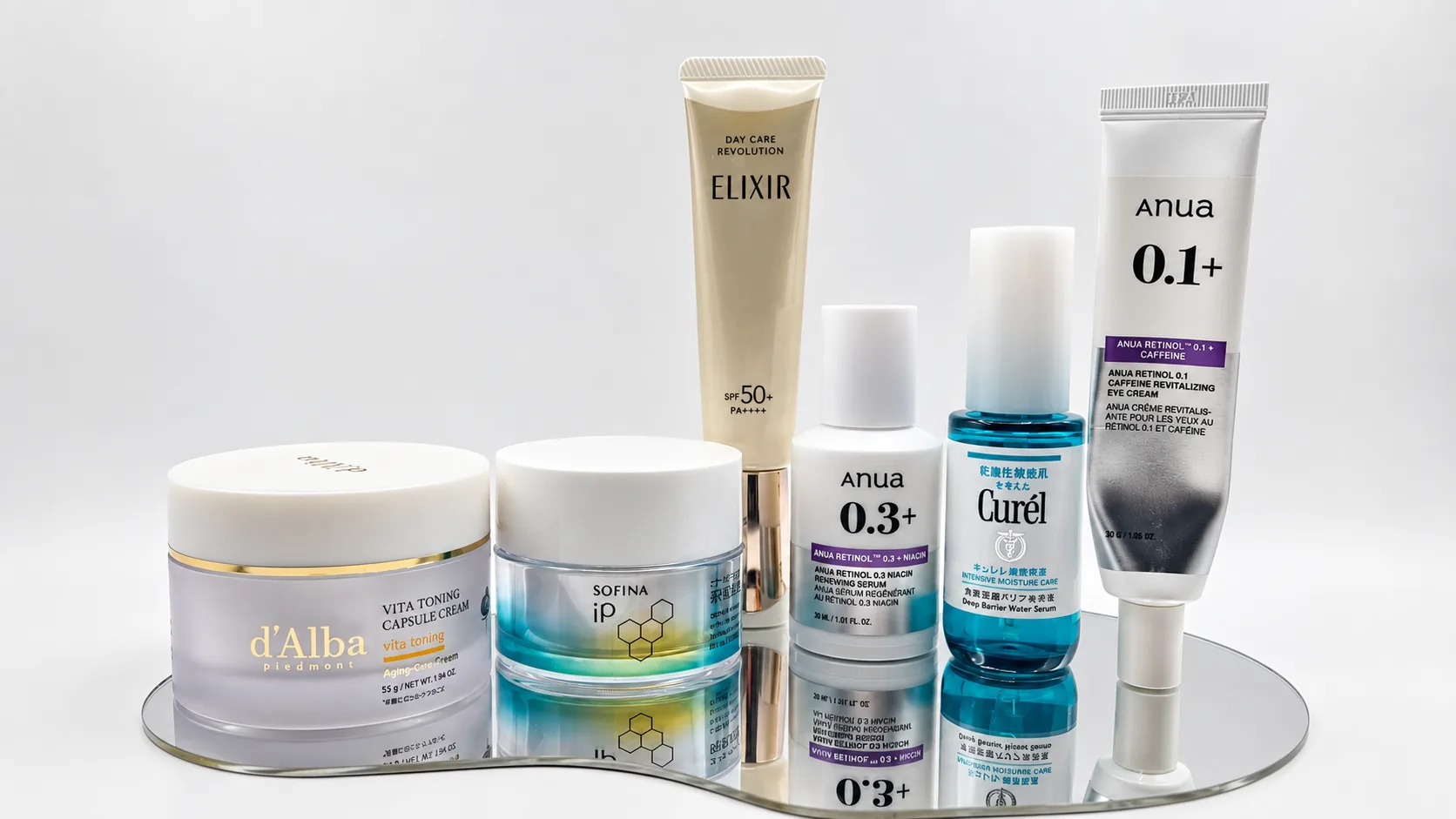
J-Beauty and K-Beauty have more in common than you might think. Here’s how Japanese and Korean skincare differ, what’s trending in 2026, and how to combine both approaches.
Japanese and Korean skincare have become impossible to ignore. In Japan, you can easily find Japanese and Korean beauty products sitting next to each other in drugstores, beauty shops, and department stores.
But despite their similarities, J-Beauty and K-Beauty have slightly different philosophies, textures, ingredients, and beauty goals.
Japanese skincare traditionally focuses on hydration, skin-barrier care, prevention, and simple routines that are easy to maintain. Korean skincare is often associated with innovative ingredients, targeted treatments, layered hydration, and glowing, dewy skin.
In 2026, however, the line between the two is becoming less obvious. Korean skincare is moving toward simpler routines, while Japanese brands are increasingly experimenting with fermentation, advanced formulations, and new textures.
So what is actually different between Japanese and Korean skincare — and which trends are worth paying attention to in 2026?
Japanese vs Korean Skincare at a Glance
| Japanese Skincare | Korean Skincare | |
|---|---|---|
| Main focus | Hydration, barrier care, prevention | Hydration, targeted treatments, skin quality |
| Typical approach | Simple and consistent | More targeted and ingredient-focused |
| Popular textures | Lotions, emulsions, creams, lightweight gels | Essences, ampoules, serums, gels, masks |
| Desired finish | Soft, hydrated, healthy-looking skin | Plump, smooth, radiant, dewy skin |
| Common ingredients | Ceramides, rice, ferments, hyaluronic acid, green tea | Snail mucin, centella, peptides, PDRN, rice, ferments |
| 2026 direction | Barrier support, gentle hydration, fermentation | High-performance ingredients, glass skin, slow-aging, streamlined routines |
These are broad tendencies rather than strict rules. Both countries have everything from minimalist products to highly active formulas.
What Is J-Beauty?
J-Beauty, or Japanese beauty, is often built around consistency rather than constantly changing products.
The philosophy is relatively simple: keep the skin hydrated, protect the skin barrier, use sunscreen, and avoid unnecessarily aggressive routines.
Japanese skincare products are often designed to feel comfortable enough for everyday use. Lightweight lotions, moisturizing emulsions, sunscreens, cleansing oils, and barrier-supporting creams are especially common.
Rather than focusing on one viral ingredient, Japanese brands often concentrate on the overall formulation and how the product feels when used every day.
This is one reason Japanese skincare can seem understated compared with some Korean beauty launches. The packaging may be simple, the textures elegant, and the claims less dramatic — but the products are designed to fit easily into a long-term routine.
Japanese skincare in 2026
One interesting development in Japanese beauty is the growing interest in fermented ingredients and advanced delivery systems.
A good example is FERTHÉA by Kracie, a new Japanese skincare brand launched in September 2026. The brand uses its proprietary fermentation technology, including what it calls “Liposome Fermentation Drip,” bringing a more modern, technology-focused approach to the traditional Japanese interest in fermentation.
At the same time, ceramides and skin-barrier care remain important.
Products such as Curél are designed specifically around dry and sensitive skin, with a strong emphasis on moisturizing and supporting the skin’s protective barrier.
This combination of traditional Japanese skincare ideas and newer cosmetic technology is one of the most interesting directions in J-Beauty right now.
What Is K-Beauty?
K-Beauty, or Korean beauty, has built its reputation around innovation.
Korean brands are particularly good at introducing new textures, ingredient combinations, packaging concepts, and highly targeted products.
The classic image of K-Beauty is the famous multi-step skincare routine. But in 2026, that image is becoming outdated.
You don’t necessarily need ten steps to follow a Korean skincare philosophy.
Instead, modern K-Beauty is increasingly about choosing effective products that solve specific skin concerns while keeping the overall routine manageable.
Serums, ampoules, essences, masks, exfoliating products, and targeted treatments remain extremely popular, but there is also a clear movement toward simpler routines.
Japanese vs Korean Skincare: What’s Actually Different?
The biggest difference is not that one country uses completely different ingredients from the other. In reality, there is a huge amount of overlap.
The difference is more about how products are formulated and how skincare is approached.
Japanese skincare tends to emphasize:
- Long-term skin maintenance
- Hydration
- Skin-barrier support
- Prevention
- Gentle daily care
- Comfortable textures
- Consistency
Korean skincare tends to emphasize:
- Targeted skin concerns
- Innovative ingredients
- Visible skin texture and radiance
- Layered hydration
- New cosmetic technologies
- Experimental formulations
- Rapidly changing trends
A Japanese routine may feel more predictable and understated, while a Korean routine may feel more experimental.
But modern J-Beauty and K-Beauty are moving closer together.
Japanese brands are introducing increasingly sophisticated formulations, while Korean brands are embracing simpler routines and long-term skin health.
Glass Skin vs. Mochi Skin
This is where the difference becomes particularly interesting.
What Is Glass Skin?
Glass skin is one of the most recognizable K-Beauty aesthetics.
The goal is skin that looks:
- Extremely hydrated
- Smooth
- Plump
- Clear
- Radiant
- Almost reflective
The emphasis is on a luminous, dewy appearance.
But the glass-skin trend has also evolved. In 2026, the focus is shifting away from simply making skin as shiny as possible.
Instead, the modern interpretation is more about healthy-looking, hydrated, smooth and bouncy skin.
What Is Mochi Skin?
Mochi skin is a beauty descriptor often associated with soft, supple, plump-looking skin.
Think of the texture of mochi: soft, smooth, hydrated, and slightly bouncy.
The finish is generally less intensely glossy than classic glass skin.
The two aesthetics are not official skincare systems. They are beauty terms used to describe different skin finishes.
And, realistically, you can have elements of both.
The Biggest Korean Skincare Trends in 2026
K-Beauty continues to move quickly, and several ingredients and concepts are particularly visible in 2026.
PDRN
PDRN has become one of the biggest buzzwords in Korean skincare.
It is appearing in serums, creams, masks, and other formulations positioned around skin recovery, hydration, and a more youthful-looking complexion.
PDRN is a major trend, but it is worth separating cosmetic marketing from proven clinical results. A product containing PDRN is not automatically a miracle anti-aging treatment.
Snail Mucin
Snail mucin remains one of the signature K-Beauty ingredients.
It is popular because of its moisturizing, soothing, and skin-conditioning properties, and it continues to appear in everything from essences to creams.
Centella Asiatica
Centella, often called cica, continues to be popular for products designed to calm and moisturize the skin.
It fits perfectly with the broader 2026 movement toward supporting the skin barrier rather than constantly exfoliating or irritating the skin.
Peptides
Peptides are another major skincare trend.
They are increasingly used in products aimed at maintaining smoother-looking, firmer, healthier skin and are no longer limited to expensive anti-aging products.
Overnight and Wrapping Masks
Overnight masks remain popular because they combine skincare with convenience.
Instead of adding numerous products during the day, a richer nighttime product can provide concentrated moisturizing care while you sleep.
What’s Trending in Japanese Skincare in 2026?
Japanese skincare trends are somewhat quieter, but there are several important developments.
Fermentation
Fermented ingredients have long been associated with Japanese beauty, and modern brands continue to develop more sophisticated fermentation-based formulations.
Ceramides and Barrier Care
The skin barrier remains a major focus, especially for people dealing with dryness or sensitivity.
Japanese brands are particularly strong in this category, with products designed to provide substantial hydration without necessarily feeling heavy.
Lightweight Hydration
Japanese skincare continues to excel at lightweight moisturizing.
Instead of applying a thick cream immediately, many Japanese routines use watery lotions, emulsions, gels, and lightweight creams that provide hydration without a greasy finish.
This is especially appealing in Japan, where hot and humid summers can make heavy skincare uncomfortable.
Japanese vs Korean Skincare Ingredients
There is no strict division between Japanese and Korean ingredients. Many popular ingredients are used by brands from both countries.
Still, some ingredients are particularly associated with each beauty market.
Ingredients commonly seen in Japanese skincare
- Rice
- Fermented ingredients
- Ceramides
- Hyaluronic acid
- Green tea
- Squalane
- Tranexamic acid
- Botanical extracts
Ingredients strongly associated with K-Beauty
- Snail mucin
- Centella asiatica
- PDRN
- Peptides
- Propolis
- Rice
- Fermented ingredients
- Exosome-related formulations
The important thing is not where an ingredient comes from, but whether the finished formulation suits your skin.
A Korean serum can work perfectly with a Japanese moisturizer, and there is no reason to restrict yourself to one country’s products.
Japanese and Korean Skincare Products You’ll See in Japan
If you shop for skincare in Japan, you will quickly notice that Japanese and Korean products are now part of the same beauty landscape.
Some Japanese brands worth knowing include:
- Curél
- ELIXIR
- SOFINA iP
- Kracie
- Hada Labo
- Shiseido
Popular Korean brands commonly found in Japan include:
- Anua
- d’Alba
- Dr.G
- VT
- numbuzin
The interesting part is how naturally these products can work together.
For example, you could use a lightweight Korean serum for a specific concern and finish with a Japanese moisturizer focused on hydration and barrier care.
Can You Combine Japanese and Korean Skincare?
Absolutely.
In fact, combining the two approaches can make a lot of sense.
You don’t need to decide between J-Beauty and K-Beauty.
A simple combination could look like this:
Morning
- Gentle cleanser
- Hydrating lotion or toner
- Korean serum or ampoule
- Japanese moisturizer
- Sunscreen
Evening
- Cleanser
- Hydrating lotion or essence
- Targeted serum
- Moisturizer or cream
You can also switch the products depending on the season.
In hot Japanese summers, lightweight Korean or Japanese hydrating products can feel more comfortable. During colder months, a richer Japanese cream may be useful for protecting against dryness.
The goal is not to use as many products as possible. The goal is to build a routine that your skin actually tolerates and that you can maintain consistently.
Which Should You Buy?
There is no universal winner between Japanese and Korean skincare.
Your choice can depend on what you want from your routine.
Japanese skincare may appeal to you if you prefer:
- Simple routines
- Comfortable textures
- Barrier-focused products
- Everyday hydration
- Minimal irritation
- Long-term consistency
Korean skincare may appeal to you if you enjoy:
- New ingredients
- Targeted serums and ampoules
- Innovative textures
- Dewy skin
- Glass-skin aesthetics
- Trying new skincare trends
And you don’t have to choose only one.
One of the best things about shopping for skincare in Japan in 2026 is that J-Beauty and K-Beauty are both easily accessible, so you can build a routine around your skin rather than around a particular country.
Where to Buy Japanese and Korean Skincare in Japan
Japanese drugstores and beauty retailers now carry a surprisingly large selection of both Japanese and Korean skincare.
Depending on the location, you can find Korean brands at stores such as:
- Matsumoto Kiyoshi
- Welcia
- Cocokara Fine
- Sugi Drug
- Sun Drug
Larger stores usually have a better selection of Korean brands, while Japanese products are available almost everywhere.
For popular or newer Korean products, availability can change quickly, so it is worth checking several stores rather than assuming that every branch carries the same products.
Final Thoughts
The biggest difference between Japanese and Korean skincare is not the ingredients. It is the approach.
J-Beauty traditionally emphasizes consistency, hydration, prevention, and protecting the skin barrier.
K-Beauty has built its reputation around innovation, targeted treatments, new ingredients, and highly hydrated, radiant skin.
But in 2026, the two approaches are becoming increasingly similar.
Korean skincare is moving toward simpler routines and long-term skin health, while Japanese skincare is embracing new technologies and sophisticated formulations.
And honestly, you don’t need to pick a side.
A good Japanese moisturizer, a Korean serum, and a reliable sunscreen can easily become part of the same routine.
The best skincare routine is ultimately the one that keeps your skin comfortable, hydrated, protected, and healthy-looking — regardless of whether the bottle says Made in Japan or Made in Korea.
FAQ
Is Japanese skincare better than Korean skincare?
Neither is universally better. Japanese and Korean skincare have different product philosophies and strengths, and the best choice depends on your skin type, concerns, preferences, and tolerance.
What is the main difference between J-Beauty and K-Beauty?
J-Beauty traditionally focuses on simple, consistent hydration and skin-barrier care. K-Beauty is more strongly associated with targeted treatments, innovative ingredients, and radiant, dewy skin.
Is Korean skincare still popular in 2026?
Yes. Korean skincare remains highly visible internationally, with ingredients such as PDRN, snail mucin, centella, and peptides continuing to attract attention.
What is glass skin?
Glass skin describes a very smooth, hydrated, plump, and luminous complexion associated with K-Beauty.
What is mochi skin?
Mochi skin is a beauty term describing soft, supple, hydrated, and bouncy-looking skin with a less intensely glossy finish.
Can I use Japanese and Korean skincare together?
Yes. There is no reason to limit a skincare routine to products from one country. Japanese and Korean products can easily be combined as long as the individual formulas work well for your skin.
Is Japanese skincare minimalist?
It can be, but not every Japanese skincare routine is minimalist. The idea of J-Beauty is better understood as an emphasis on consistent, comfortable, long-term skincare rather than a fixed number of products.
Is the 10-step Korean skincare routine still relevant?
The traditional multi-step routine is still useful as a concept, but modern K-Beauty is increasingly focused on streamlined routines and choosing products based on specific skin needs.



No responses yet