

You don’t always need an hour at the gym to be more active. Sometimes, a few minutes here and there can be a much easier place to start.
Finding time for exercise can be surprisingly difficult. There is work, errands, cooking, social plans, and all the small things that fill an ordinary day. And when a workout feels like it needs to be 45 minutes or an hour, it is very easy to keep putting it off.
That is where exercise snacking comes in.
The idea is simple: instead of waiting for one perfect block of time to exercise, you add short bursts of movement throughout your day.
A few squats while your coffee is brewing. Walking during a phone call. Taking the stairs. Stretching between work tasks. Going for a short walk after lunch.
It doesn’t necessarily feel like a workout — and that is part of the appeal.

What Is Exercise Snacking?
Exercise snacking means adding short, separate bouts of physical activity throughout the day instead of relying only on one longer workout.
Recent research has started looking more closely at this approach. A systematic review published in August 2026 describes exercise snacks as brief bouts of moderate-to-vigorous activity that can be incorporated into everyday routines and may help overcome some of the practical barriers to regular exercise.
Other 2026 research has found that exercise-snacking interventions may improve cardiorespiratory fitness in adults, although the evidence is still developing and results can vary depending on the type, frequency, and duration of activity.
In everyday life, though, the concept is much less complicated than it sounds.
It can simply mean moving more often.
Why Exercise Snacking Makes Sense for Real Life
The biggest advantage is convenience.
You might not have an hour available for a workout. But you probably have a few minutes here and there.
Maybe you have five minutes before your next meeting. Ten minutes after lunch. A few minutes while dinner is cooking. Fifteen minutes while you’re on the phone.
Instead of thinking, I don’t have time to exercise today, exercise snacking changes the question to:
Where could I add a little more movement today?
That feels much more achievable.
And it doesn’t mean abandoning regular workouts if you enjoy them. Exercise snacks can simply be another way to break up long periods of sitting and add movement to an otherwise sedentary day.
Current physical-activity guidelines still recommend that adults get at least 150 minutes of moderate-intensity activity each week, plus muscle-strengthening activity on at least two days. That activity can be spread throughout the week rather than completed all at once.
So think of exercise snacks as another tool, not a replacement for everything else.
What Counts as an Exercise Snack?
It doesn’t have to be complicated.
A few examples:
- Do some squats while your coffee brews.
- Walk around while you’re on the phone.
- Take the stairs instead of the elevator.
- Stretch after sitting at your desk.
- Walk around the block after lunch.
- Put on music while you’re cooking and move around the kitchen.
- Walk to a nearby shop instead of driving.
- Do a few simple bodyweight exercises between tasks.
- Take the longer route home.
- Get up and move for a few minutes when you’ve been sitting for a while.
The important thing is not to make every movement break feel like a mini fitness class.
The easier it feels, the more likely you are to actually do it.
Make Your Walk More Than Just Exercise
This is probably my favorite way to use the idea.
Go for a walk — but give yourself somewhere pleasant to go.
Instead of deciding that you need to walk for exactly 30 minutes, walk to a café.
Get a coffee.
Sit outside for a few minutes.
Browse a small shop or bookstore.
Walk through a park.
Take a different street home.
Then keep walking.
Suddenly, you have turned a basic walk into a little outing.
And you don’t have to spend the entire time walking quickly or thinking about how many steps you’ve accumulated. The point is simply to be outside, move your body, and enjoy the time.
This is especially nice in autumn, when cooler temperatures make wandering around the neighborhood much more appealing.
A coffee stop can become part of the walk rather than the destination itself.
It is also the kind of Simple Wellness Habits that can become part of your day without requiring a completely new routine.
10 Easy Exercise Snacks for a Normal Day
1. While Your Coffee Brews
Instead of reaching for your phone while waiting for the kettle or coffee machine, try a few squats, calf raises, or gentle stretches.
You only need a couple of minutes.
2. Between Work Tasks
Finished one task and about to start another?
Stand up first.
Walk around the room, refill your water, stretch, or step outside for a few minutes.
That small pause can be a useful way to break up a long period of sitting.
3. Take the Stairs
This is one of the easiest ways to add movement without scheduling anything.
If you normally take the elevator for a few floors, take the stairs when it feels comfortable for you.
4. Walk During Phone Calls
Have a phone call that doesn’t require you to sit in front of a screen?
Walk while you talk.
A 15-minute conversation can become a 15-minute walk without taking any extra time out of your schedule.
5. Take a Short Walk After Lunch
You don’t need to turn your lunch break into a serious workout.
Walk around the block, wander through a nearby street, or take a slightly longer route before returning to work.
It’s one of the easiest ways to add a little more movement to an otherwise sedentary afternoon.
6. Put Music On While You’re Cooking
Waiting for the pasta to boil?
Put on a song.
Move around the kitchen. Put things away. Stretch. Dance if you feel like it.
It doesn’t have to look like exercise to get you moving.
7. Add a Short Evening Walk
If you’ve spent most of the day indoors, a few minutes outside can be a nice transition between work and the rest of your evening.
You don’t need a destination.
Just walk around the block and come home.
8. Make Your Errands More Active
Need to pick up a few things?
If the shop is nearby, walk instead of driving.
Already out?
Take the longer route home.
Small choices like these can add movement without creating another item on your schedule.
9. Use Natural Breaks When Watching TV
You don’t need to exercise through an entire episode.
When an episode finishes, stand up.
Get some water, tidy the room, stretch, or walk around for a few minutes before starting the next one.
10. Take the Scenic Route
Sometimes the easiest exercise snack is simply choosing the longer way.
Walk through the park.
Get off public transport one stop earlier when practical.
Take the quieter street home.
The goal isn’t to make every journey longer. It’s just to notice the opportunities that are already there.
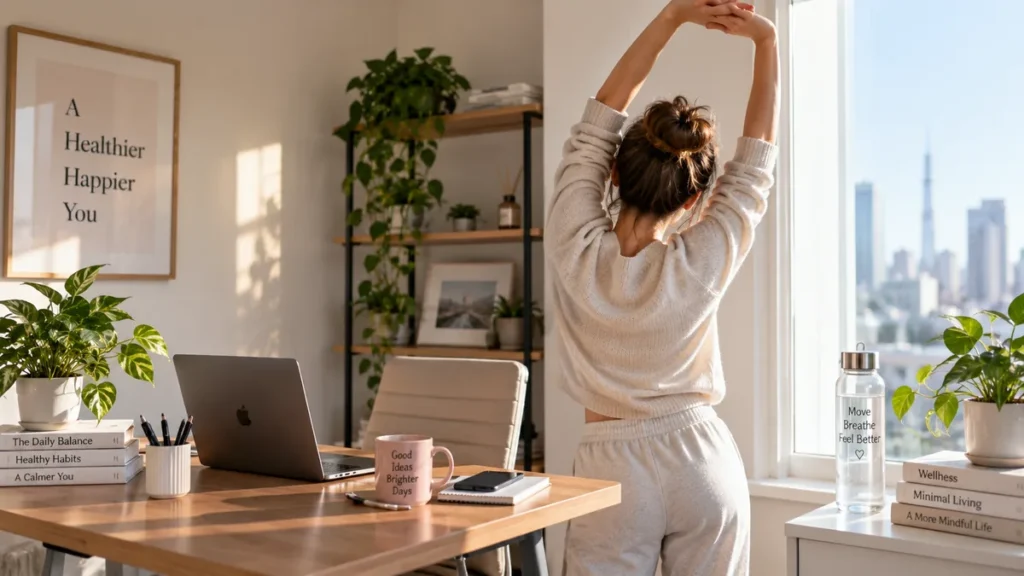
You Don’t Have to Turn Every Minute Into Exercise
This is where I think the idea can easily go too far.
A simple wellness habit appears, and suddenly there is a perfect schedule for it.
Five minutes at 9:00.
Three minutes at 11:30.
Ten minutes after lunch.
Another five minutes before dinner.
Before you know it, your “easy” movement routine has become another thing to manage.
That misses the point.
Exercise snacking should make movement easier, not make your day more complicated.
If you already have a workout routine you enjoy, keep it.
If you don’t, these small bursts of activity can be an accessible way to start moving more.
And if you only manage one short walk on a particularly busy day, that’s fine too.
What About Five Minutes?
Five minutes is still five minutes.
You don’t need to wait until you have enough time for a “proper” workout before you move.
A short walk is still a walk.
A few flights of stairs are still movement.
Getting up from your desk and walking around is better than staying in the same position for another hour.
Research on exercise snacks is promising, particularly around cardiorespiratory fitness and breaking up sedentary time, but researchers are still studying which formats, intensities, and schedules work best.
So there is no need to treat a five-minute movement break as a miracle fitness hack.
It’s simply one small opportunity to move.
A Simple Exercise-Snacking Day
Here’s what it could look like in real life.
Morning
Make coffee → a few squats and stretches.
Mid-morning
Finish a work task → get up and walk around for a few minutes.
Lunch
Eat → take a short walk outside.
Afternoon
Phone call → walk while talking.
After work
Walk to a nearby café → get a coffee → continue wandering around the neighborhood.
Evening
Before settling in for the night → take a short walk or stretch at home.
That’s it.
You didn’t have to rearrange your entire day around exercise.
You simply found a few places where movement could fit naturally.
Make Your Autumn Walk a Little Ritual
Autumn is probably one of the easiest seasons to make this work.
You don’t necessarily need a fitness goal every time you leave the house.
Sometimes you can just put on a jacket, grab your coffee and go.
Walk through the neighborhood.
Look at the changing leaves.
Stop at a café.
Browse a bookstore.
Take a few photos.
Sit somewhere for ten minutes.
Then walk home.
On some days, it might be 15 minutes.
On others, it might turn into an hour.
Both are fine.
An autumn walk can be movement, fresh air, a change of scenery, and a little autumn self-care at the same time.
And that is much more appealing to me than treating wellness as another list of things you are supposed to accomplish every day.
Don’t Turn Movement Into Another Wellness Rule
There is something I particularly like about exercise snacking: it doesn’t require perfection.
Some days you’ll walk for an hour.
Some days you’ll take the stairs.
Some days you’ll stretch for two minutes.
And some days you’ll be tired and do very little.
That’s normal.
The best habits are usually the ones that can survive an imperfect day.
You don’t need a complicated morning routine or a perfectly optimized schedule to take care of yourself. A short walk, some fresh air, and a few minutes away from your screen can already make your day feel different.
The same philosophy works beautifully with a simple evening routine: keep the habits you actually enjoy and let the rest go.
The Bottom Line
Exercise snacking isn’t really about finding a new way to work out.
It’s about changing the way you think about movement.
You don’t have to wait until you have an hour free.
You can move while your coffee brews.
Walk while you’re on the phone.
Take the stairs.
Walk to a café.
Take the scenic route home.
Stretch after sitting.
Go outside for ten minutes.
None of these things needs to become a performance.
Movement doesn’t always have to be a workout. Sometimes, it’s simply part of your day.
FAQ
What is exercise snacking?
Exercise snacking is a way of adding short, separate bouts of physical activity throughout the day instead of relying only on longer workouts. Research into the approach is growing, although there is not yet one universally agreed format for how long or how often an exercise snack should be.
How long is an exercise snack?
There is no single required duration. Research has examined brief bouts of activity lasting from around one or two minutes to several minutes, depending on the activity and study design.
Can walking count as an exercise snack?
Yes. A brisk walk is one simple way to add physical activity to your day, especially when walking replaces some time that would otherwise be spent sitting.
Can exercise snacks replace a workout?
They can complement a regular exercise routine and make it easier to accumulate movement throughout the day, but they should not be treated as a magic replacement for all other forms of physical activity. Current guidelines still recommend regular aerobic and muscle-strengthening activity.



No responses yet