
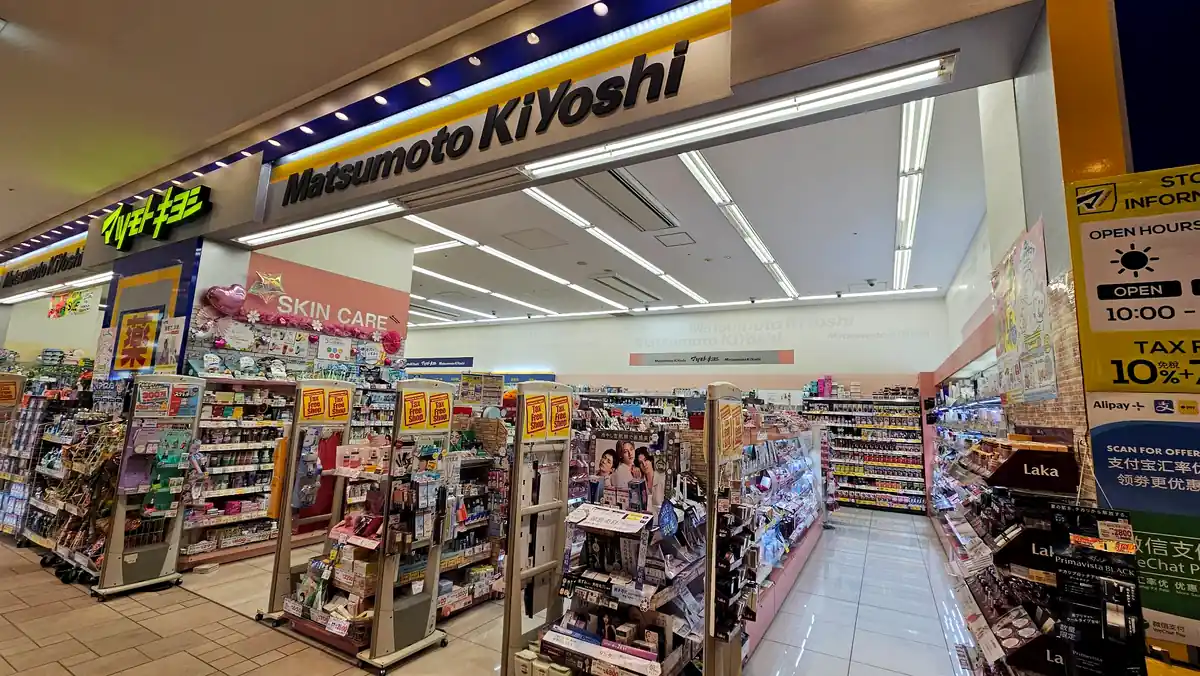
If you’ve ever walked into a Japanese drugstore, you’ve probably noticed that the supplement section is much bigger than you expected.
There are shelves of Japanese vitamins, collagen powders, beauty supplements, minerals, probiotics, DHA and EPA, biotin, ceramides, hyaluronic acid, and multivitamins. Some products are designed for general nutrition, while others are marketed specifically for skin, hair, beauty, or women’s health.
And then there is the collagen section.
It can be an entire shelf by itself.
I took these photos in Japan because they show what the Japanese supplement market actually looks like in a real store. These aren’t carefully selected products arranged for a photoshoot — this is the kind of choice you can encounter when shopping for supplements in Japan.
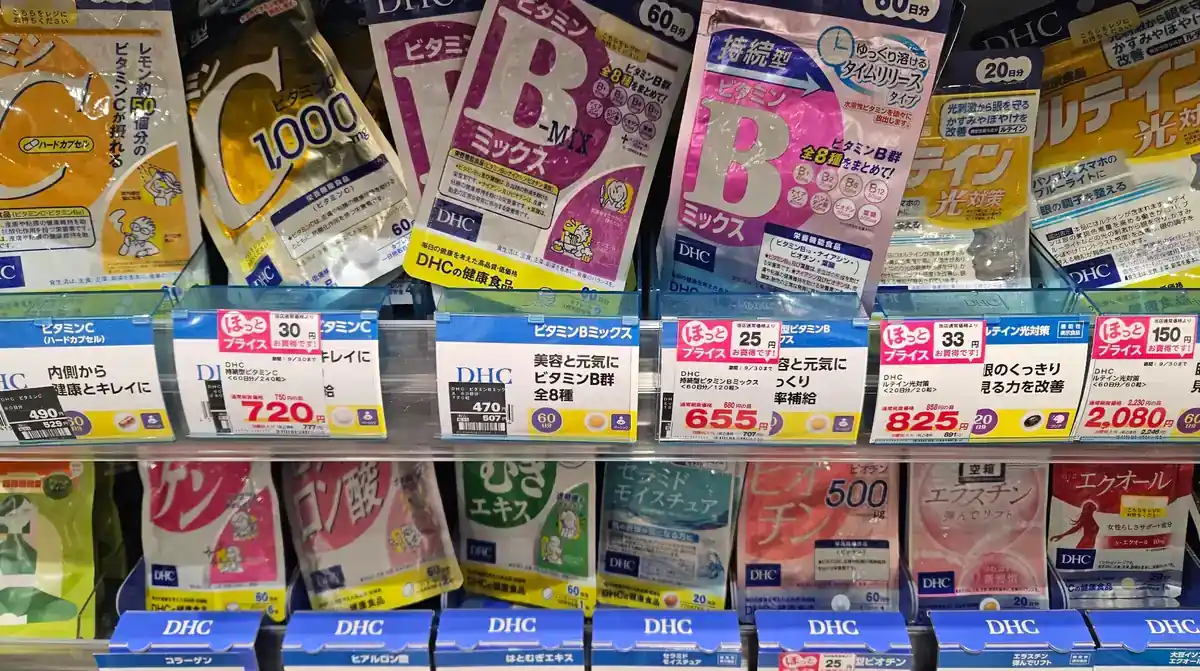
Among the products visible here are Meiji Amino Collagen, Asahi Perfect Asta Collagen, and other collagen products. Further along the supplement aisles, you’ll find DHC vitamins, minerals, beauty supplements, and much more.
So what are all these products for, and what should you actually look for?
What Makes Japanese Supplements Different?
Japanese supplements are sold as foods and nutritional products, rather than as medicines. The market includes everything from basic vitamins and minerals to highly specialized beauty supplements.
One of the most noticeable things about shopping for supplements in Japan is how clearly products are divided by purpose.
You can find supplements for:
- General nutrition
- Vitamins and minerals
- Skin and beauty
- Hair and nails
- Collagen
- Bone health
- Energy and daily wellness
- Fish oil and DHA/EPA
- Digestive health
- Sports and active lifestyles
Brands such as DHC, Meiji, and Asahi Group Foods have extensive ranges, so there is usually much more choice than you might expect from a regular pharmacy.
But more choice doesn’t mean you need more supplements.
For women over 40, the useful question isn’t “What should I take because I’m over 40?” It’s “What do I actually need?”
Japanese Collagen Supplements Are Everywhere
If you are interested in Japanese beauty supplements, collagen is probably the first category you’ll notice.
Japanese collagen supplements come in several forms:
- Powder
- Tablets
- Capsules
- Ready-to-drink bottles
- Individual sachets
The main difference is convenience, serving size, additional ingredients, and price.
Meiji Amino Collagen
Meiji Amino Collagen is one of the best-known Japanese collagen products.
The Premium powder provides 5,000 mg of collagen peptides per 7 g serving, together with vitamin C, hyaluronic acid, CoQ10, ceramides, arginine, and glucosamine.
The powder format is practical because you can mix it into a drink or food instead of taking multiple tablets.
And there is an interesting new development for 2026.
Meiji launched Amino Collagen Ca styles in Japan in September 2026. The formula combines 5,000 mg of collagen peptides with calcium, vitamin D, and hyaluronic acid per 7 g serving. Meiji specifically positions it around the nutritional needs that can become more relevant for women as they get older.
That makes it a particularly interesting product to notice when shopping for Japanese supplements for women over 40.
Asahi Perfect Asta Collagen
Another major name is Asahi Perfect Asta Collagen.
The Premium Rich powder provides 5,500 mg of collagen per 7.5 g serving and contains a long list of additional ingredients, including hyaluronic acid, ceramides, vitamin C, CoQ10, placenta extract, probiotics, and several other components.
This is a good example of how Japanese beauty supplements often combine several ingredients into one product rather than selling collagen alone.
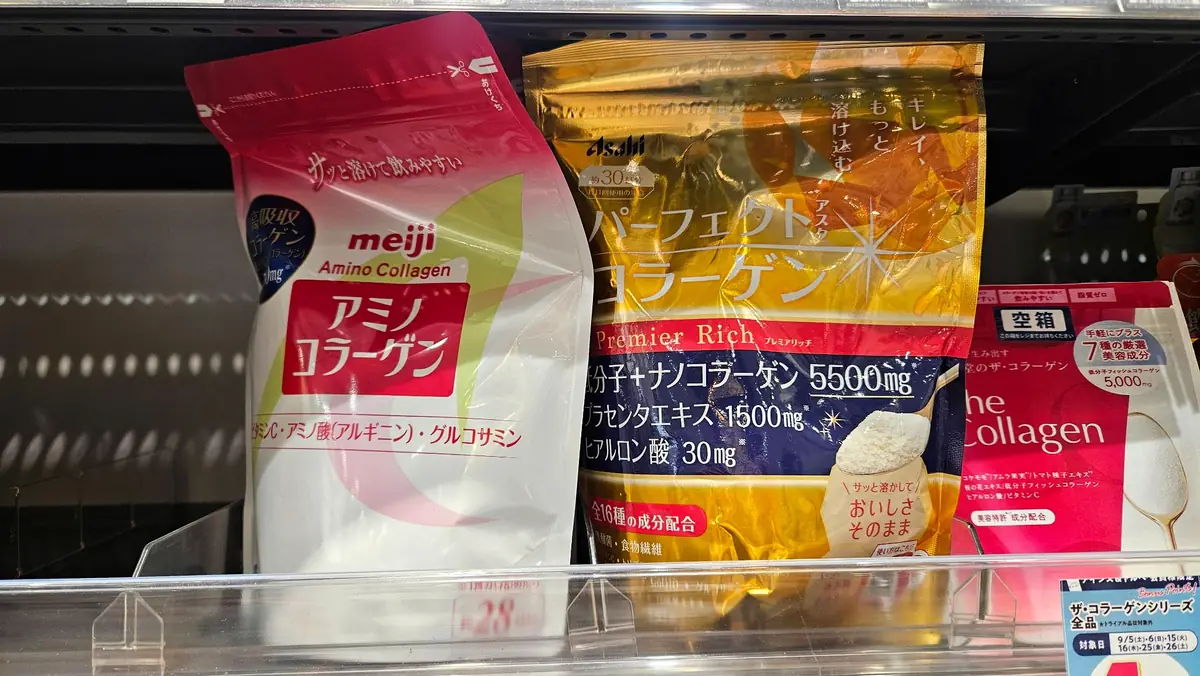
DHC Collagen: A Different Format
DHC is one of the easiest Japanese supplement brands to recognize.
Its collagen product comes in tablet form rather than powder. The recommended daily serving is six tablets, providing 2,050 mg of fish-derived collagen peptides, along with vitamins B1 and B2.
This illustrates an important point when comparing Japanese collagen supplements.
A product with a larger number on the front isn’t automatically better.
Meiji, Asahi, and DHC use different serving sizes, formats, collagen amounts, and additional ingredients. If you’re comparing products in Japan, look at the amount per recommended serving, not just the large number printed on the package.
Collagen Powder vs. Tablets vs. Drinks
Which format is best?
There isn’t one answer.
Collagen powder
Good if you don’t mind mixing a supplement into coffee, tea, yogurt, smoothies, or another food or drink.
It can also provide a substantial collagen dose without swallowing several tablets.
Collagen tablets
Convenient and easy to carry.
The downside is that some products require several tablets per day.
Collagen drinks
Probably the easiest option when you’re travelling or simply don’t want to prepare anything.
Meiji’s Amino Collagen Drink, for example, contains 5,000 mg of fish collagen peptides in a 125 ml bottle.
The disadvantage is that ready-to-drink products can be less economical than powder.
For everyday use, I’d compare serving size, ingredients, price per serving, and convenience rather than choosing based on packaging.
Japanese Vitamins: More Than Just Multivitamins
Collagen gets a lot of attention, but Japanese drugstores have an enormous selection of ordinary vitamins too.

Your photo shows just how extensive the selection can be.
You can find:
- Vitamin C
- Vitamin D
- Vitamin E
- B-complex
- Biotin
- Multivitamins
- Zinc
- Calcium
- DHA and EPA
- Other vitamins and minerals
DHC currently offers individual vitamin products as well as multivitamin formulas. Its range includes vitamin C, vitamin D, vitamin E, B vitamins, biotin, folic acid, and multivitamin products.
This is one of the advantages of shopping for Japanese vitamins: if you are looking for one particular nutrient, you don’t necessarily have to buy a huge combination product.
Vitamin D and Calcium Become More Interesting After 40
There is a reason these two nutrients deserve attention when discussing women over 40.
Calcium is needed for normal bone health, while vitamin D contributes to normal calcium metabolism and bone health.
This doesn’t mean that every woman over 40 should automatically start taking calcium or vitamin D supplements.
Your needs depend on your diet, lifestyle, sun exposure, health history, and other factors.
But the subject is becoming more visible in the Japanese supplement market.
Meiji’s new Amino Collagen Ca styles, for example, combines collagen with 210 mg of calcium and 12.5 μg of vitamin D per 7 g serving, alongside 5,000 mg of collagen peptides and 20 mg of hyaluronic acid.
It is an interesting example of how Japanese beauty supplements are increasingly combining beauty and general wellness in one product.
Biotin, Ceramides and Hyaluronic Acid: The Beauty Shelf
This is where Japanese supplement shopping becomes particularly interesting.
Look at the products in the photos and you’ll see ingredients that most people normally associate with skincare:
Ceramides.
Hyaluronic acid.
Biotin.
Collagen.
Elastin.
Photo 4 — DHC beauty supplements
[INSERT YOUR PHOTO 3]
These products are often marketed as beauty supplements or supplements designed to support skin, hair, nails, or overall appearance.
It is a very Japanese approach to beauty: skincare doesn’t necessarily stop at the bathroom shelf.
However, there is an important distinction.
A supplement containing hyaluronic acid is not the same thing as applying a hyaluronic-acid serum to your skin.
A collagen supplement isn’t a replacement for sunscreen.
And a biotin supplement isn’t a guaranteed solution for hair loss.
The ingredients may have legitimate nutritional or physiological roles, but marketing claims should always be viewed in context.
What Is DHC?
If you are shopping for supplements in Japan, you’ll probably come across DHC very quickly.
The brand has a huge range of nutritional products, including:
- Vitamins
- Minerals
- Collagen
- Biotin
- DHA/EPA
- Multivitamins
- Beauty supplements
- Other health-focused formulas
DHC’s current multivitamin provides 11 vitamins in one daily tablet, including vitamins B1, B2, B6, B12, C, D, and E, as well as niacin, pantothenic acid, biotin, and folic acid.
There are also combination products. For example, DHC’s Multivitamin/Mineral + Q10 combines 11 vitamins, 10 minerals, and CoQ10 in one formula.
That variety is convenient, but it also creates one potential problem: it’s very easy to buy too much.
Do Women Over 40 Need Supplements?
Not simply because they turned 40.
This is probably the most important point in the entire article.
There is no universal list of “must-have supplements for women over 40.”
One woman may have a balanced diet and need very little supplementation. Another may have a nutritional deficiency, dietary restriction, or specific health need that requires a particular supplement.
Your age alone doesn’t tell you what you need.
Before buying several Japanese supplements, ask:
What am I trying to improve?
Then look at the label.
Check:
- Active ingredients
- Amount per serving
- Recommended daily serving
- Serving duration
- Allergens
- Other supplements you already take
This is especially important when using several products at the same time.
For example, a multivitamin may already contain vitamin D, while another beauty supplement may contain it as well. Adding a third product without checking the labels can result in unnecessary duplication.
What I Would Look for in a Japanese Drugstore
If you’re visiting Japan and want to explore the supplement aisle, don’t start by filling your basket.
Start with the labels.
Look for clear information
A good label should tell you what the product contains and how much you are supposed to take.
Compare the serving size
A product with “5,000 mg” on the front may sound impressive, but always check whether that amount is per tablet, per serving, or per entire package.
Check the ingredients
Long ingredient lists are common in Japanese beauty supplements. More ingredients don’t automatically mean a better product.
Consider the format
Powder may be cheaper and more flexible. Tablets may be easier when travelling. Drinks may be the most convenient but can cost more.
Don’t double up unnecessarily
If you’re already taking a multivitamin, check it before adding separate vitamin D, B-complex, biotin, or other products.
Japanese Beauty Supplements Are Not Magic
The Japanese supplement aisle can make beauty look wonderfully simple:
Take collagen.
Take biotin.
Take hyaluronic acid.
Add vitamin C.
And you’re done.
Real life is more complicated.
Sleep, nutrition, movement, strength training, sun protection, stress management, and regular healthcare still matter far more than having a shelf full of supplements.
Supplements can be useful, but they should support your lifestyle rather than replace it.
DHC itself describes supplements as a complement to a balanced diet and exercise habits, rather than a substitute for them.
That’s probably the healthiest way to look at the entire category.
My Favorite Part of Shopping for Supplements in Japan
What I find most interesting isn’t one particular brand.
It’s the sheer variety.
A single Japanese drugstore can have a section for Japanese collagen supplements, another for vitamins and minerals, another for beauty products, and shelves full of specialized formulas.
And the packaging tells you a lot about how Japanese companies approach wellness: practical, specific, and often very focused on everyday routines.
Photo 5 — Wider photo of the Japanese supplement shelves
[INSERT NEW PHOTO FROM YOUR NEXT SHOPPING TRIP HERE]
This is also why I think taking your own photos while shopping in Japan makes an article like this much more useful. A reader can see the actual shelves, packaging, product categories, and the sheer number of choices before deciding what to look for.
What Should You Actually Buy?
If you’re standing in a Japanese drugstore and don’t know where to start, don’t start with the most expensive product.
Start with your goal.
Looking for general nutrition?
Look at basic vitamins and minerals and consider whether you actually need them.
Interested in Japanese beauty supplements?
Compare collagen, ceramide, hyaluronic acid, and beauty-focused formulas — but keep your expectations realistic.
Interested in collagen?
Compare Meiji Amino Collagen, Asahi Perfect Asta Collagen, and DHC Collagen by serving size, collagen amount, ingredients, format, and price.
Looking for something specifically for women over 40?
Pay attention to overall nutrition, bone health, protein intake, physical activity, sleep, and preventive healthcare rather than assuming one supplement can cover everything.
Final Thoughts
The supplement shelves in Japan can be overwhelming, but they are also a fascinating introduction to the country’s approach to beauty and wellness.
You’ll find everything from basic Japanese vitamins to sophisticated collagen powders and beauty supplements containing ceramides, hyaluronic acid, biotin, and other ingredients.
Collagen is one of the biggest categories, with well-known products from Meiji, Asahi, and DHC. But there is much more to Japanese supplements than collagen.
For women over 40, the smartest approach is not to buy the longest list of supplements.
It’s to understand what you’re buying, check the serving size, compare the ingredients, and choose products that actually make sense for your diet and lifestyle.
And if you’re in Japan, take a look at the supplement aisle.
Just be warned: you may walk in looking for vitamin C and leave wondering whether you suddenly need three different types of collagen.
FAQ: Japanese Supplements for Women Over 40
What are the most popular Japanese supplements?
Collagen, vitamin C, vitamin D, B vitamins, multivitamins, minerals, DHA/EPA, and beauty supplements are widely available in Japanese drugstores. Collagen is particularly prominent in the Japanese beauty supplement market.
What is the best Japanese collagen supplement?
There is no single best product for everyone. Meiji Amino Collagen, Asahi Perfect Asta Collagen, and DHC Collagen all have different formats and formulas. Compare collagen per serving, additional ingredients, price, and convenience before choosing.
What Japanese supplements are popular for women over 40?
Common categories include collagen, vitamin D, calcium, multivitamins, vitamin C, biotin, ceramides, and other beauty supplements. However, individual needs vary, so age alone isn’t a reason to take a particular supplement.
Where can I buy Japanese supplements?
You can find Japanese supplements in many drugstores and pharmacies across Japan. Larger stores generally offer a wider selection of brands and products.
Is DHC a Japanese supplement brand?
Yes. DHC is a Japanese company with a large range of vitamins, minerals, collagen, beauty supplements, and other health products.
Are Japanese collagen supplements worth trying?
Collagen supplements are popular in Japan and come in many formats, but they shouldn’t be viewed as a guaranteed anti-aging treatment. If you want to try one, compare the actual collagen amount per serving and the complete ingredient list.
Should women over 40 take a multivitamin?
Not necessarily. A multivitamin can be useful in some circumstances, but whether you need one depends on your diet, nutritional intake, health, and individual circumstances.
Are Japanese beauty supplements better than regular vitamins?
They serve different purposes. Beauty supplements often combine ingredients such as collagen, ceramides, hyaluronic acid, biotin, and vitamins, while regular supplements may focus on specific nutrients. Neither category is automatically better.



No responses yet